
Joan Mitchell
Imaginary Things

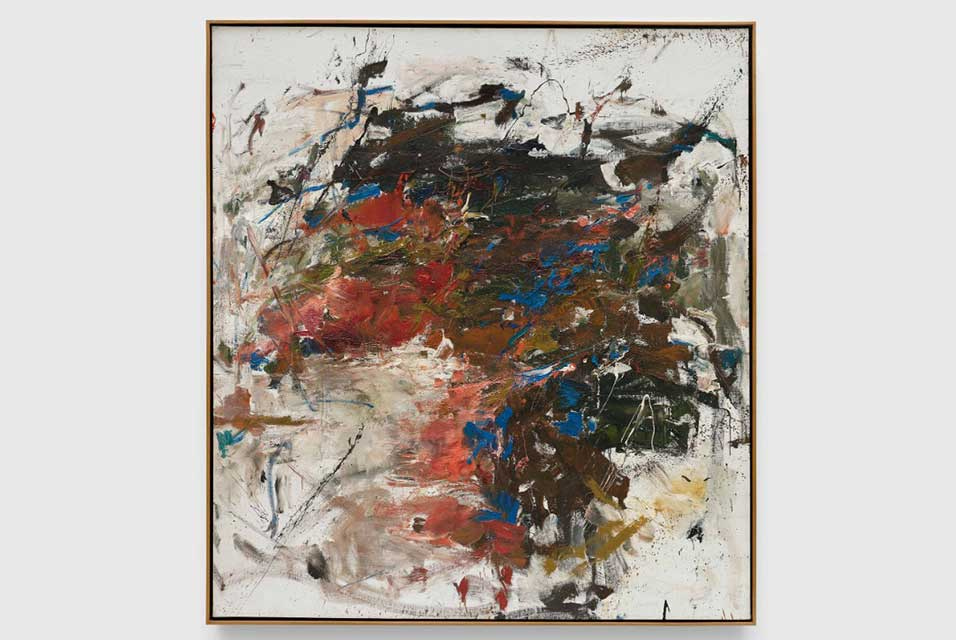
After the better part of a lifetime convinced that the pursuit of art would lead me to meaning, art has lost me. The connection between form and content was always tenuous, and now it feels broken. I can see through art’s poses as it tries to deal with theory, history, and politics at the expense of perception itself. And that makes me feel terribly empty.
Then I saw this painting by Joan Mitchell and I saw my own seeing. It was a blessing of pareidolia, I was bestowed with a vision similar to seeing faces on Mars, or elephants in clouds.
We rarely see what’s actually in front of us, especially if it’s something we don’t want or expect. So instead, we fill in those self-inflicted perceptual blanks, and those patches are where beauty might be generated. Art does its best to induce that experience.
Art starts with a projection of our hopes and illusions onto a painting that engages us. A useful painting is a jagged patch created to puncture our habits and snare our perception. It gives us the opportunity to see something in ourselves. Art can arrive this way, and it might be the only way. That I don't know.
Clement Greenberg said ambiguity is one of the chief sources of pleasure in art, and Joan Mitchell made a figure ground relation built on intense ambiguity. When the figure is seen it seems obvious, and when you don’t see it, it simply doesn’t exist. It’s an “aha” of recognition.
If you’re flexible about what could constitute an object in a space, then there’s one to see in this painting. It creates its own space different from the room and our ordinary experience. The edges of the painting are a window-frame into that different space.
A successful painting has its own depth, its own scale, and it’s coherent. Mitchell's painting contains an attractor analogous with gravity hidden somewhere in the virtual space. It pulls in all the coloured things around it.
I generally assume that the edges of a painting or drawing are stationary, they are, after all, a frame of reference, or a “window” as I called it above. And if there appears to be any movement within the frame, it is the objects within that move. Mitchell’s ‘object’ has come right up to the inside of the picture plane. It’s almost nose to nose with the viewer.
In that regard, it’s a different experience from film or video where the frame is frequently expected to move with camera pans and zooms. Video assumes there is an ordinary space somewhere that has been captured. For what it's worth, I think an immovable frame is a fundamental characteristic of painting and drawing. That stability is a source of power.
This painting contains a conglomeration of paint that doesn’t depict any kind of object I’ve ever experienced in ordinary life. It could be read, not as an object at all, but rather as either physical deposits of paint, or the flat surface of a non-mimetic (abstract) painting that seems to warp on account of colour dynamics, what Hans Hofmann called the “push-pull” of various colours.
But Mitchell’s painting seems to contain a strange, inexplicable object that could well be moving left or right, up or down, and towards or away from the viewer. It’s free to move as a distinct object anywhere in its space. It seems oddly real. It's hot, it's cold, it absorbs, it reflects, it has associated things that appear to approach it or retreat. It has a lot of thing-ness despite the fact it doesn't seem to have a perimeter.
For quite some time I’ve wanted to say a word or two about this extraordinary painting. But I haven’t posted anything in a long time because first, I was travelling, and then I fell while curling and cracked some ribs. I have been going through a long recovery process. I don’t claim to be some sort of saint, but I find myself grateful for new insights into what it’s like to be here embodied, vulnerable, and separate. In other words, to be an occupant of an object (my body).
Thanks for reading and be well.
Steve
Are you ISTP Gallery, i.e. one and the same?
Gertrude